

Trust AI for the Next Phase of Enterprise Automation
Al agents are no longer experimental tools. They reason, make decisions, and act autonomously across platforms like:
- Salesforce
- ServiceNow
- and more
The Opportunity is Significant. So is the Risk.
Provar TrustAI helps organizations establish trust AI governance across enterprise systems by validating how AI agents behave, respond, and evolve over time.
Al Quality Lifecycle Management for Enterprise AI Agents
Provar TrustAl is built for this moment. It is the first enterprise platform designed to
give technology leaders confidence that Al agents will behave predictably, securely,
and in line with business and regulatory expectations — at scale.
Built for modern AI quality management, TrustAI enables organizations to validate, govern, and scale enterprise AI systems with confidence.
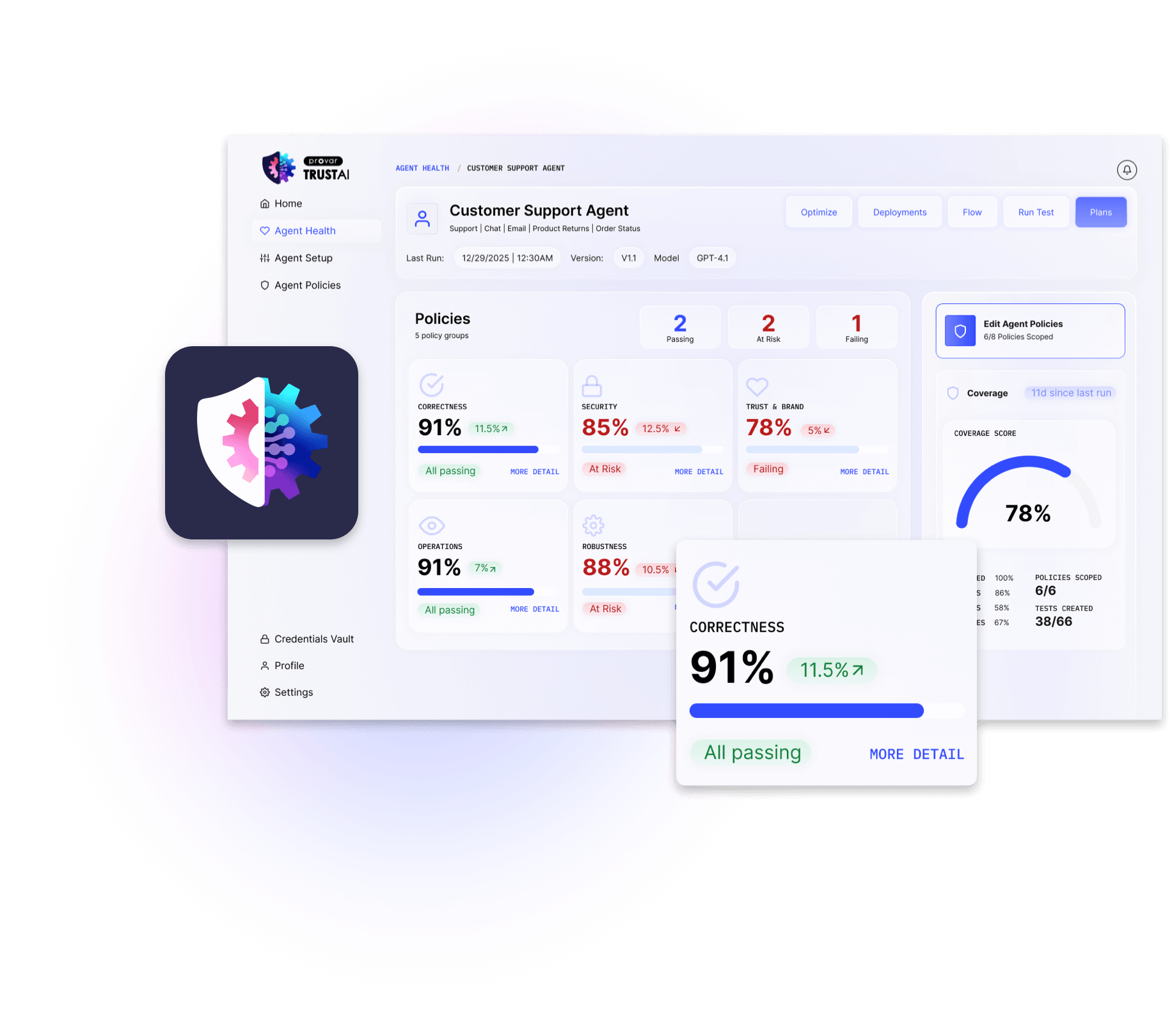
Agent visibility with continuous assurance
- Purpose-built quality assurance for Al agents.
- Delivering the visibility and AI governance required to scale AI safely, confidently, and responsibly.
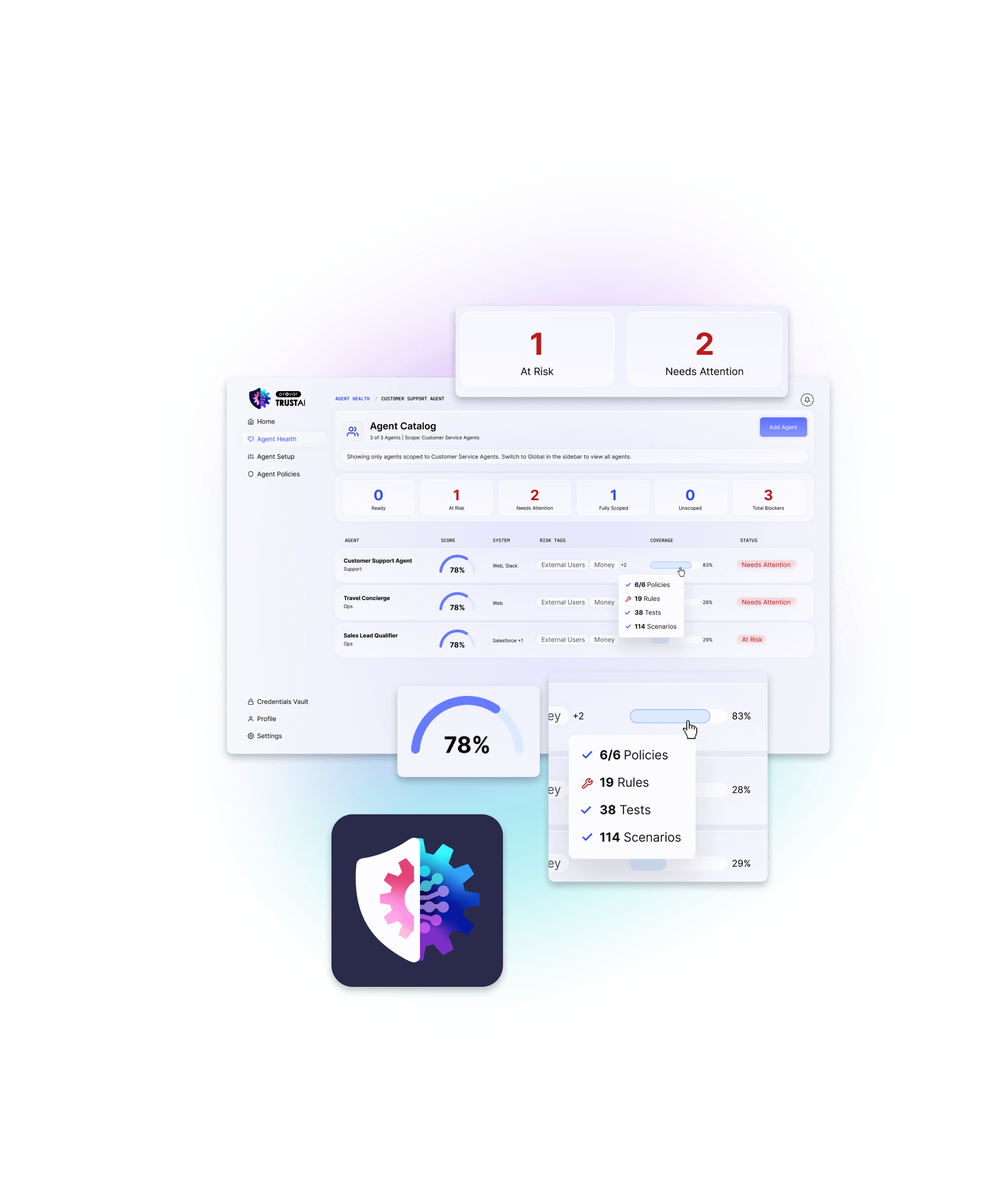
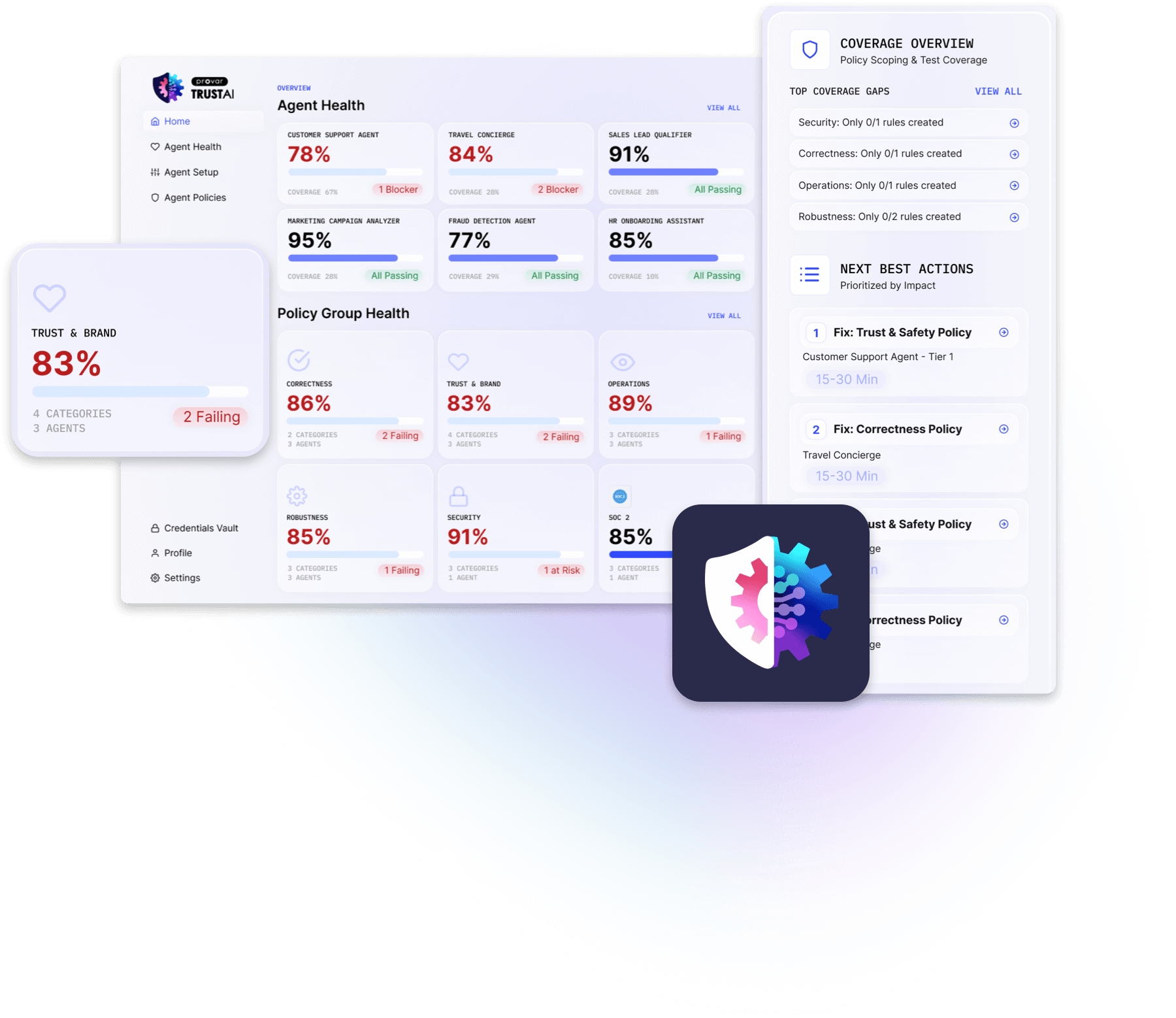
- A single, unified view of every agent across your organization.
- Clear visibility into confidence levels, adherence to guardrails, and emerging risk through continuous AI assurance and monitoring.
- Drill into any individual agent to understand the policies and rules that govern it, how it's been tested, and how its behavior evolves over time.
- This level of visibility supports stronger AI agent governance across enterprise environments.
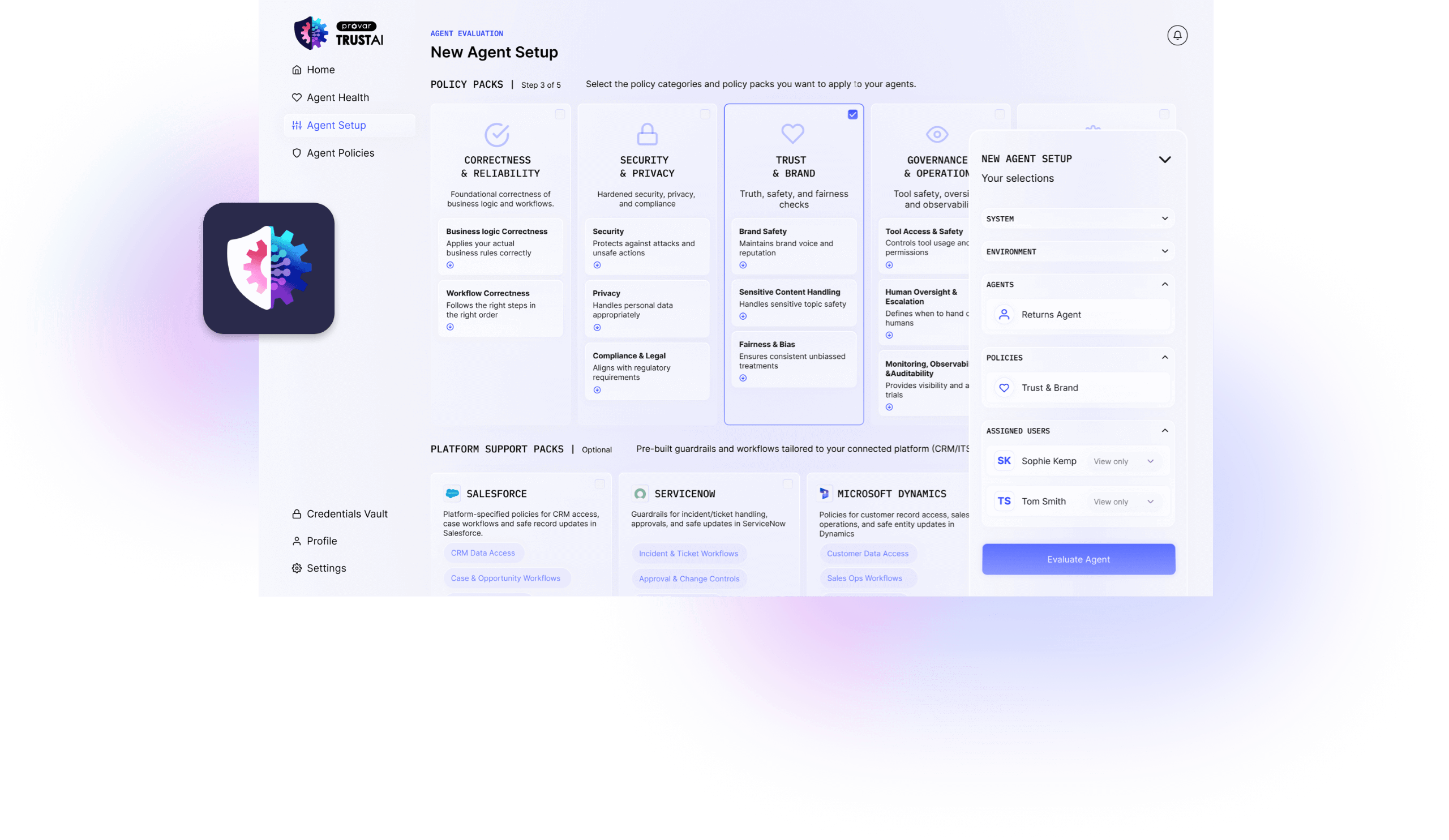
Move AI governance from documentation into execution

Establish security boundaries, compliance requirements, data usage expectations, behavioral standards, and more.

Out-of-the-box policy packs define what “good” looks like, including industry-specific frameworks for regulated environments and responsible AI initiatives.

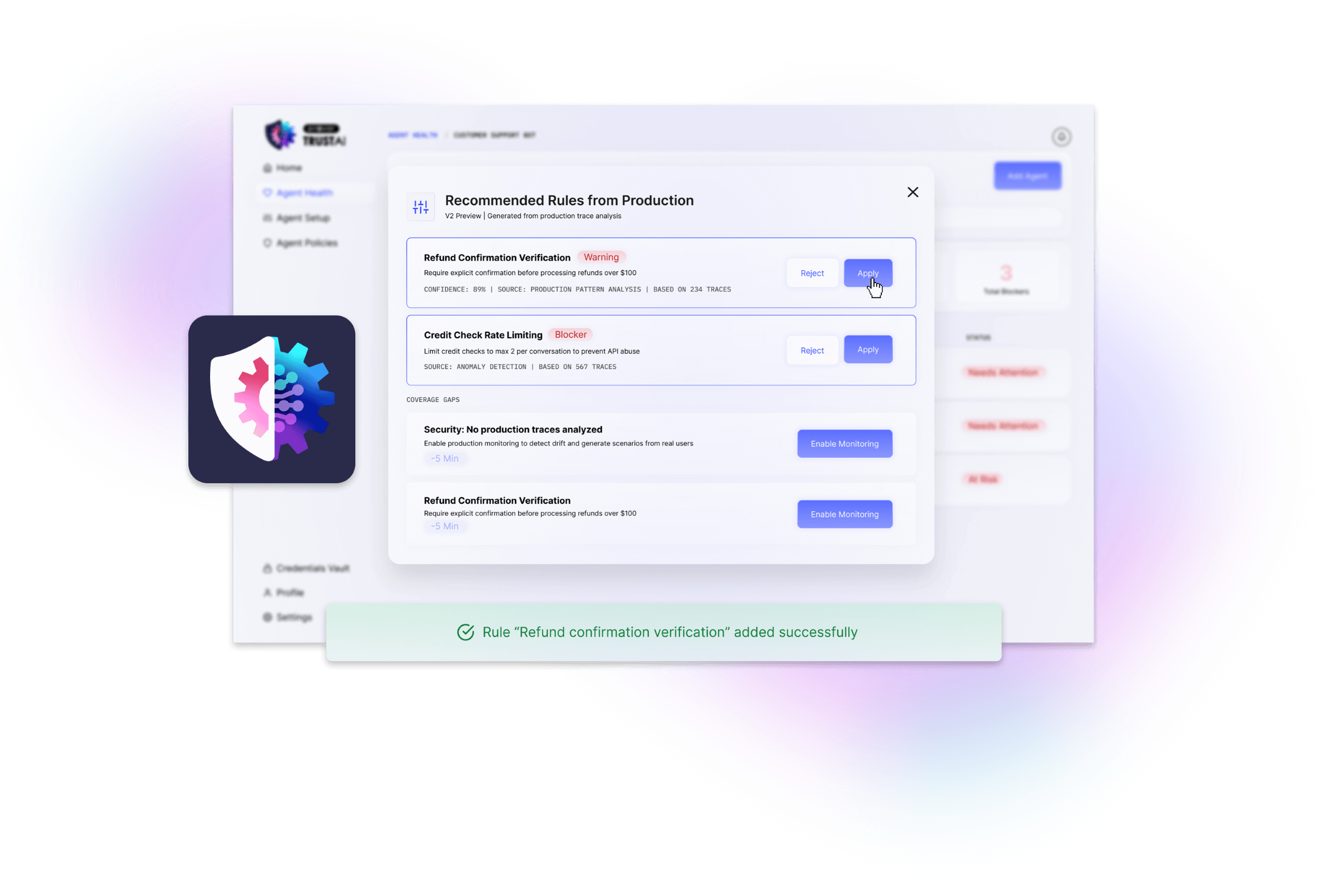
Apply them as-is, customize them, or create policies that align to your business and to your agents.
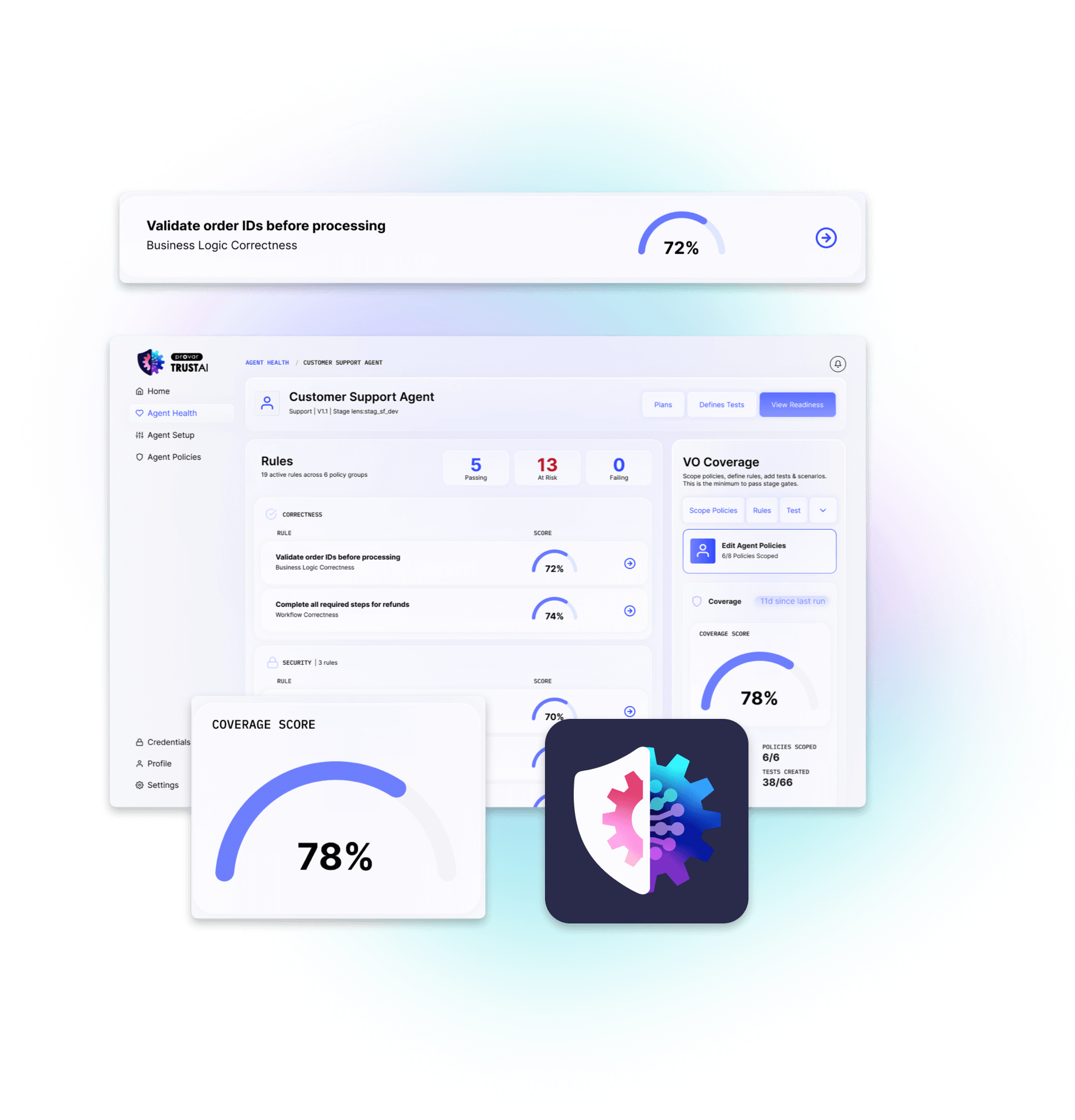
Turning Policy into Guardrails
- What data an Al agent can access
- How it's allowed to respond, and
- Which behaviors are acceptable — and which are not.
TrustAI closes the gap between business rules and agent development, ensuring AI policies are enforced consistently throughout testing and execution as part of broader AI risk management.
Policy-driven testing for AI agents
- Automatically evaluate agents against defined policies and rules.
- Run tests at any stage of the lifecycle, from development and UAT through staging and production.
- Automated AI agent testing focuses on expected behavior, edge cases, and high-risk scenarios, including hallucination and response drift.
- Extend and refine coverage using natural language — without slowing delivery or creating new bottlenecks.
This enables scalable AI compliance testing across enterprise workflows.
Continuous monitoring for Al agent trust

Continuous monitoring of Al agent behavior in production feeds real-world signals back into the quality assurance process.

When agent behavior changes, confidence drops, or drift appears, TrustAI detects it early through continuous AI monitoring — reinforcing trust through smarter testing and adaptive validation.

Why TrustAI Exists
AI innovation is moving faster than enterprise trust.
While agents are increasingly embedded in real workflows — handling customer interactions, operational decisions, and cross-system processes — most organizations lack the mechanisms to truly understand, validate, and govern how those agents behave.
Existing quality, testing, and governance models were designed for deterministic software. They were never built to assure systems that reason, adapt, and change over time.
This creates a growing need for enterprise AI governance and trustworthy AI validation frameworks.
This has created a growing confidence gap:
AI Initiatives Stall in Pilots
Without clear AI assurance and governance models, organizations struggle to move AI initiatives into production safely.
Risk Accumulates Quietly in Production
Insufficient AI risk management and monitoring can allow harmful behaviors and compliance issues to go undetected.
Agents are Not Trusted with High Value Use Cases
Without scalable trust AI frameworks, enterprises hesitate to deploy AI agents into critical workflows.
Introducing Provar TrustAI
Provar TrustAI is the trust layer for the Agentic Enterprise.
It introduces a new discipline: AI Quality Lifecycle Management — a continuous approach to assuring AI agents from development through production. Designed for modern enterprise AI governance, TrustAI helps organizations scale trustworthy AI systems with confidence.
TrustAI gives enterprises a single platform to:

Validate AI agent decisions, responses, and actions through continuous AI agent testing and monitoring across the full lifecycle.

Identify model drift, hallucinations, and behavioral anomalies before they create operational or compliance risks through proactive AI assurance and continuous validation.

Generate explainable and traceable evidence to support AI governance, regulatory requirements, and enterprise compliance initiatives.

Continuously strengthen agent performance and reliability with ongoing AI quality management and feedback-driven optimization.

This is not a point-in-time control.
It is continuous assurance for AI systems that never stand still.
- Discover
- Trust
- Optimize
A Practical Framework for Enterprise AI Assurance
Trust is earned through proof, not promises.
TrustAI continuously tests and validates agent behavior before and after deployment. It verifies that agents act accurately, securely, and within defined boundaries as data, models, and systems evolve.
Risky behavior, including hallucinations, drift, or policy violations, is identified early, with explainable evidence that supports audit, compliance, and executive accountability.
Get In Touch With
Provar’s Test Automation Experts
Expert Guidance: Provar experts can help you find the right test automation solution tailored to your needs. Seamless Integration: Learn how Provar works effortlessly with Salesforce and your DevOps ecosystem. Real ROI: Discover how Provar customers achieve faster releases, improved test coverage, and reduced maintenance.